Beyond the Ethanol Hype

Wikipedia From the first season of The West Wing, the writers of the show have taken several jabs at the U.S. policy on ethanol subsidies, claiming that it takes more energy to produce ethanol than it provides. On hearing that today was the first day of the Kyoto Accord, I got to wondering if there was any merit to their criticism. After slogging through a google-space full of hype, it finally dawned on me to check out the Wikipedia, which, unsurprisingly, provides a very balanced look at ethanol as fuel (and occupies a first-page position in a google search for ethanol, if I had bothered to read more carefully).

What does it say?

A 2002 report by the United States Department of Agriculture concluded that corn ethanol production in the U.S. has a net energy value of 1.34, meaning 34% more energy was produced than what went in. This means that 75% (1/1.34) of each unit produced is required to replace the energy used in production. MSU Ethanol Energy Balance Study: Michigan State University, May 2002. This comprehensive, independent study funded by MSU shows that there is 56% more energy in a gallon of ethanol than it takes to produce it.

Though hardly a spectacular result, it is positive. Perhaps ethanol isn’t a complete write-off after all, though ethanol producers seem to be milking the government for all its worth.

Out with the New; In with the Old

When I first thought up the new name for this site, I really liked the double entendre of “Within Our Ken”. After about a week, it didn’t seem nearly as witty. After a month, it started getting lame. Today, I despised it; so much so that I have changed it back to the original site name. It may be plain, but I know I can live with it.

Evolution of Text Input Devices

AlphaGrip AG5TThis recent story on Slashdot about the release of the AlphaGrip AG5T got me thinking about the state of computer input devices today. While I find the AG5T a welcome advance over the traditional flat keyboard, I have to wonder why we are still stuck on this old model of generating text by hacking out a single character at a time. Is it possible to design an input device capable of generating syllables, or even whole words, in a single stroke? Would human minds be capable of productively using such a device?

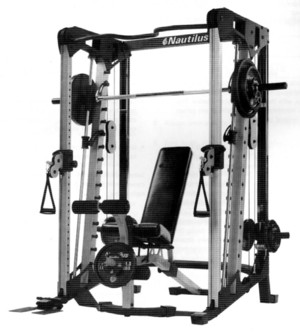
Review of Nautilus NT-CC1 Smith Machine with Cable Crossover Continued

NT CC1

I wrote the first part of my review soon after purchasing the NT-CC1. Because I hadn’t used it very much, I had more to say about assembling the machine than I did about actually using it. Now that I’ve had a few weeks to put it through its paces, I’d like to share with you some of my impressions and experiences.

I bought the machine for its versatility. On this count, I have yet to be disappointed. This is an incredibly versatile machine. For every major muscle group, I’ve been able to find several exercises convenient.

  • legs: squat, leg extension, hamstring curl, calf raise
  • shoulders: military press, standing arm raise (to side and to front), shrugs
  • chest: flat, incline, and decline bench presses
  • back: upright row, lower cable row, chin up
  • arms: single-handed and bar curl, tricep push down, overhead tricep extension
  • abs: sit-up on decline bench, crunch on flat bench

The machine is wonderfully versatile. Every time I use it, I’m discovering new exercises to do. The variety of exercises I can do with this machine seems to be limited only by my own creativity, which at times does appear to be somewhat limited. For example, I haven’t been able to think of a good exercise to work my lower back yet. And I seem to be running out of ideas for different ways to do bicep curls (after finding four or five variations).

As several readers have commented, I too have missed having a lat pulldown bar, though I’m not sure how I would use one if one was included. There isn’t anything on the machine that you can use to brace yourself from lifting your body. On a couple of occasions I tried a variation of a lat pulldown by sitting on the floor in between the two cables, with the pulleys mounted near the top, and a handle in each hand. With a low weight, I could achieve the motion I wanted, but once I increased the weight, I ended up just lifting myself off the ground.

I also wish the machine had come with a straight bar so I could vary the width of my grip when doing curls. This is no biggy, though. Nothing is stopping me from buying an after market bar.

A weight tree would be nice too. These are also available after market.

The operation of the machine is excellent. I had some problems early on with the bar getting a little sticky, especially in the upper range of motion, due to dust settling on the top of the bushing. I’ve found that a can of spray-on silicone lubricant is essential to keeping the smith machine moving smoothly. I wipe down the shafts with a rag before applying the lubricant, which seems to extend the amount of time between lubes. When I’m not using the smith machine, I store the bar on the top rung so any dust that does settle on the bushing doesn’t interfere with the usual range of motion.

Overall, I continue to be very impressed with the machine. I gives me the versatility that I want, even though it requires some regular light maintenance.

P.S. My thanks goes to Thomas Glass, whose tenacious investigation of the maximal loading of the machine turned up a limit of 500lbs for the smith machine and 250lbs for each of the cable assemblies. Good work, Tom!

P.P.S There is a discussion of the NT-CC1, though nobody refers to it by model number, at the John Stone Fitness Forum that might also be of interest.

Update (2006-01-29): John Kellas wrote me with an alternative to silicone lubricant:

What I’m trying for lubricant is the wax based lubricant sold in the bike shops for mountain bike cables and chains. As it is formulated for cables and not to attract dirt, it may be the best one to use.

Will I/O be the new bottle neck?

In the anticipation and eventual announcement of IBM’s cell processor, described by Hannibal here and here, there has been a lot of talk about the plateau in clock frequencies and the ensuing rise of parallelism in chip architectures.

Bill Clementson, in the latest installment in a series on parallel programming in Lisp (see also parts 1, 2, and 3), linked to this bit of hype about the cell processor from Nicholas Blachford:

The first Cell based desktop computer will be the fastest desktop computer in the industry by a very large margin. Even high end multi-core x86s will not get close. Companies who produce microprocessors or DSPs are going to have a very hard time fighting the power a Cell will deliver. We have never seen a leap in performance like this before and I don’t expect we’ll ever see one again, It’ll send shock-waves through the entire industry and we’ll see big changes as a result.

I’m skeptical about how much of a difference in performance we would see from these highly parallel processors in PCs, especially in web and database servers, where I get the impression that there tends to be a lot of disk access. Sure, the processor with its array of cells will be able to compute much faster than a single-core design, but that doesn’t matter much if the entire system is blocked, waiting for some disk access to complete.

It seems to me that the cell architecture is ideally suited to applications with low latency in IO, such as game systems and signal processing. How are they going to perform in applications that make heavy use of hard drives? That’s what I’d like to know.

Starting with WatStart

Waterloo Technology Startup NetworkIn the grand tradition of prefixing the names of Waterloo-produced things with Wat, such as Watcom, Watstar, and WatPubs, comes WatStart:

WatStart is a new community initiative to help prospective entrepreneurs and very-early-stage technology companies in the Waterloo area.

WatStart creates opportunities for early-stage entrepreneurs to get together — online and in person — with each other and with local service providers to learn from each other and to receive ongoing guidance, support and encouragement.

Gary Will, who chronicles the Waterloo technology scene in his widely read Waterloo Tech Digest, has gathered together several local sponsors to produce a very attractive and potentially useful site. I write potentially because since its launch in early September, there has been very little activity on the website. The forums are practically dead, except for the occasional posting from sponsors, whose articles are either cut-and-paste copies of articles from somewhere else on the internet or cheesy bits of marketing fluff that you might expect to find as mail inserts with their bills. And none of it has anything to do with starting a company in Waterloo! The top non-sponsor poster has posted less than ten messages to the forum, and he’s in Mississauga!

But enough of my complaining. My point is that the site has a lot of potential. All it lacks is some interesting content — Waterloo-related content — to get people talking.

Personally, I’d like to see WatStart succeed. It’s not so much that I am interested in starting up a company in Waterloo, though I do toy with the idea from time to time, but I like living in Waterloo. I like working in Waterloo. Should I ever happen lose my current job at AMI Semiconductor, I’d like to see a thriving local high-tech industry from which I could choose another job. I think WatStart has the potential to help that happen.

All this is to say that I plan to give some attention to WatStart over the next little while: participating in discussions, asking questions, stirring the pot, trolling for conversation, teasing with flamebait, and the like. So don’t say I didn’t warn you.

Leave your name after the beep

With the relatively large volume of comments I’ve received on the NT-CC1 review, I’ve noticed that everybody is posting anonymously. I’d like to attribute this to the annoying hassle that Blogger imposes on commenters, requiring that they create a new account if they’d like to post with a name. I rather hope it is not out of a fear of retribution for the contents of their posts that nobody is posting their names. So I’ve switch commenting services. Now I’m using comments by Haloscan, which makes it a little easier to post by name.

I’ve transferred all the existing comments to the new system. Unfortunately, I was not able to preserve the time information. If you find any errors, please email me at kd at kendyck.com.

What You’ll Wish You’d Known

Eminent computer scientist, author, painter, and dot-com millionaire, Paul Graham has written down the things he wishes somebody had told him when he was in high school in What You’ll Wish You’d Known. As usual, he has a lot of interesting things to say. For instance:

One of the most dangerous illusions you get from school is the idea that doing great things requires a lot of discipline. Most subjects are taught in such a boring way that it’s only by discipline that you can flog yourself through them. So I was surprised when, early in college, I read a quote by Wittgenstein saying that he had no self-discipline and had never been able to deny himself anything, not even a cup of coffee.

Review of the Nautilus NT-CC1 Smith Machine with Cable Crossover

Last Thursday, nearing the end of a $160 promotional discount at Costco, Mandy and I purchased a Nautilus NT-CC1Nautilus NT-CC1 Smith Machine with Cable Crossover.

For reasons beyond my understanding, the Nautilus website contains no trace of the NT-CC1 at all. Not only that, there does not appear to be any mention of it on the internet anywhere. Not even Google can find a reference to it. So welcome to the only review of the Nautilus NT-CC1 on the Web.

The NT-CC1 is a combination of a Smith machine and a cable crossover. It comes with a adjustable bench (capable of upright, inclined, flat and decline positions), several attachments for the cables (handgrips, tricep rope, low row pull bar, and ankle cuff) and 205 pounds of olympic-style weights (2x45lbs, 2×25, 4×10, 4×5, and 2×2.5), not to mention a built-in chin-up bar. It retails at Costco for $949.99CAN, but after taxes and the $160 discount it came out to just over $930.

Unlike other Smith machines that I have used, the bar is not counterweighted, which means the unweighted bar is quite heavy (~45lbs), which could be unweildly for novices.

Assembly of the unit went smoothly. The assembly instructions are understandable, but somewhat lacking in illustrations (only 5 figures for 42 steps of assembly). In total, it took me around 5 hours to assemble everything, but I took my time and made a stupid mistake that I had to go back and correct [1]. I’m sure a motivated person could assemble it less than 4 hours. I had no problems getting pieces to fit; everything aligned perfectly.

I managed to find one mistake in the assembly manual, but not one that would cause any problems for somebody of reasonable intelligence. The mistake is that there are no instructions on how or when to install the top pegs on the uprights. Here’s a tip: install them at the top of the uprights in the only open slots after following all the other instructions.

I have had one workout with bench so far and am so far very impressed. The motion of the bar is very smooth. The cables move well, too, but not as smooth as other gym equipment I have used. I hope this will change with the application of some silicone-based lubrication as the assembly manual recommends. It is very versitile. The owner’s manual describes 36 exercises, but between the cables and the bar there are countless more. In fact, about half of my first workout was exercises not mentioned in the owner’s manual.

In conclusion, I am very happy with the purchase and look forward to using it regularly from now on.

[1] If you really must know, I installed the chin-up bar backwards.

[Update: see the follow up review for some of my impressions and experiences actually using the NT-CC1]